

Case Study
ERP Optimization for Manufacturing Operations
Disconnected operational and financial systems limited visibility across production planning, inventory control, and manufacturing performance tracking.
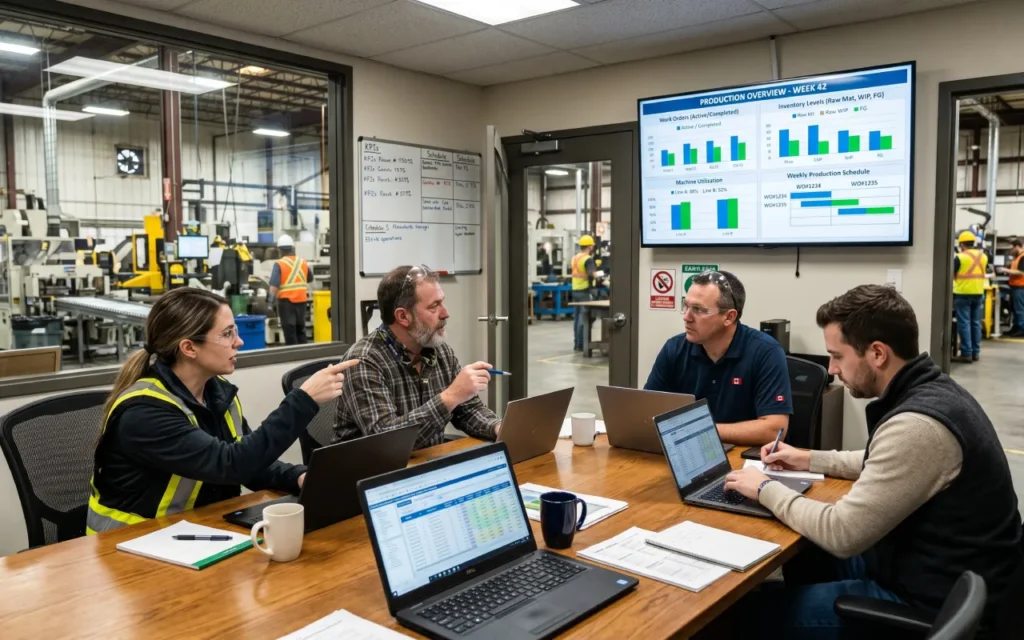
The manufacturing operation was experiencing inefficiencies in how production data, inventory information, and operational reporting were managed across systems.
Critical decisions were being made using partial or delayed information, creating misalignment between production planning, inventory availability, and actual shop floor execution.
The engagement focused on improving system alignment, strengthening data consistency, and enabling a more integrated view of manufacturing operations across planning and execution layers.
Challenge
The operating problem that needed a practical response.
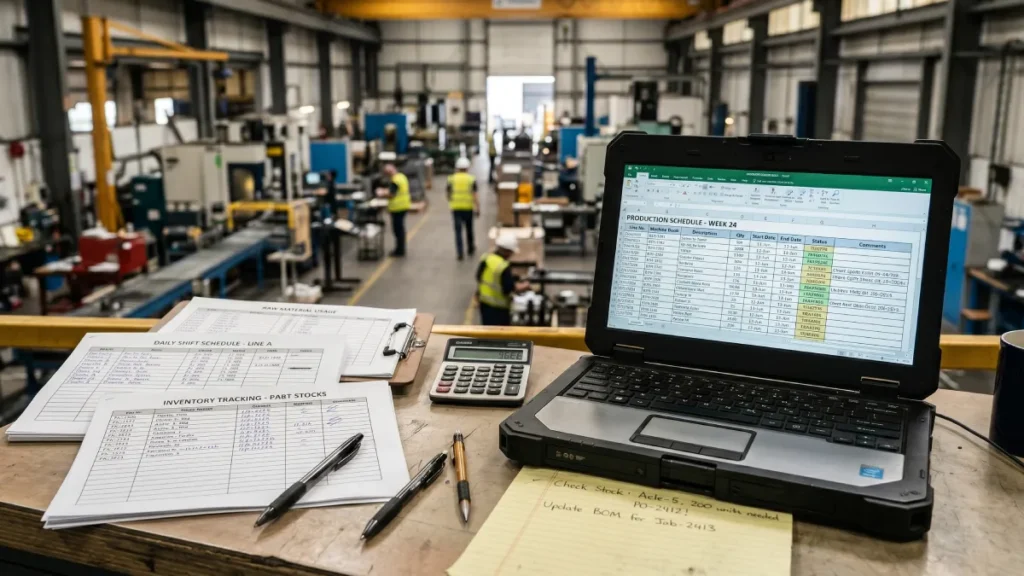
Manufacturing operations were constrained by disconnected systems that separated production planning, inventory management, and performance tracking into isolated workflows.
This lack of integration created delays in understanding actual production status and reduced the reliability of operational decision-making across teams.
- Production updates were not consistently reflected in planning systems, leading to scheduling inefficiencies.
- Inventory data was frequently outdated or misaligned with actual stock levels on the floor.
- Reporting required manual reconciliation between ERP outputs and operational records.
- Leadership lacked a unified view of production performance, cost, and utilization.
Solution and approach
The engagement focused on aligning ERP structures with actual manufacturing workflows to ensure that production, inventory, and reporting systems reflected real operational conditions.
Rather than treating ERP as a standalone system, the approach integrated it into day-to-day manufacturing execution and decision cycles.
- Discovery
- Existing ERP usage, production workflows, inventory tracking methods, and reporting structures were analyzed across manufacturing and planning teams.
- Gaps were identified between system data and actual shop floor activity, particularly in how updates flowed between production execution and inventory records.
- Design
- A revised ERP alignment model was designed to better reflect manufacturing realities, including standardized production status updates, inventory movement tracking, and reporting structures.
- Key focus was placed on ensuring consistency between operational events and system updates to eliminate interpretation gaps.
- Implementation
- ERP processes were restructured to better align with production workflows, reducing manual reconciliation and improving system accuracy.
- Teams were aligned on consistent data entry practices, and reporting structures were adjusted to reflect real-time operational states rather than delayed summaries.
- Measurement
- System alignment, reporting accuracy, and production visibility were reviewed after implementation to assess improvement in operational decision-making.
- Improvements were tracked in how quickly production status could be interpreted and how reliably inventory and planning data reflected actual conditions.
Results
The measurable change created by the engagement.
The organization moved toward a more synchronized operational model where production activity, inventory data, and reporting systems were more closely aligned.
This improved visibility into manufacturing operations reduced delays in decision-making and improved coordination between planning and execution teams.
Operational reporting became more reliable, reducing the need for manual reconciliation across systems.
Improved system alignmentBetter synchronization between production execution and ERP data structures.
Reduced manual reconciliationLess effort required to align inventory, production, and reporting information.
Stronger production visibilityMore accurate and timely understanding of manufacturing performance across teams.
Tools and systems
Systems and delivery assets used in the work.
- The engagement leveraged ERP systems, production tracking tools, inventory management processes, and reporting frameworks.
- Supporting elements included standardized data entry structures, operational alignment workflows, and simplified reporting models designed to improve system reliability without adding complexity.
Key takeaway
ERP optimization in manufacturing is most effective when it is aligned with actual production behavior rather than treated as a separate administrative system.
When system structure reflects real operational flow, visibility improves naturally and decision-making becomes faster and more reliable.